Excess and ontogenesis
Bataille and the critique of closure in physicalist science

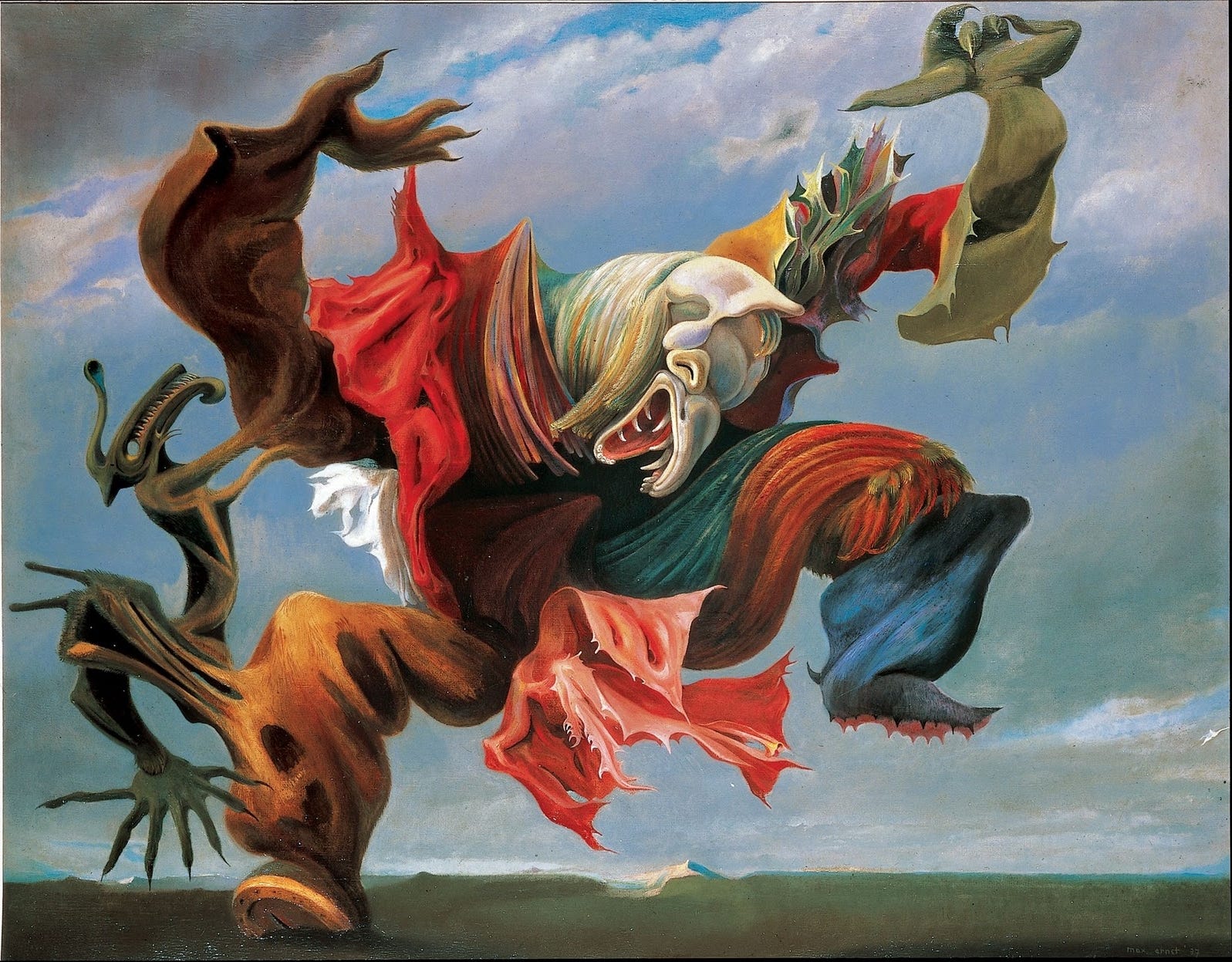
Max Ernst - L’ange du foyer
I recently appeared on Sereptie’s podcast “Lepht Hand”, you can listen to that discussion here:
During that chat, Craig made reference a couple of times to a “paper” I’d sent him on some of the themes we discussed. It’s really not so much a paper as a short, draft, introduction to the “ontogenetic thought” process (a new framing for my ongoing work, including the collaboration with Matt Segall), and a contextualisation of the thought of Georges Bataille (along with Charles Darwin, Georges Canguilhem, and Gilbert Simondon) within that work. Several people have subsequently asked if they could read the (non-)paper, so I’m sharing it…..now:
Excess and ontogenesis: Bataille and the critique of closure in physicalist science
Note on method
The point of departure for this project is deceptively simple: we reorient our conception of “Nature” (physis) from one grounded upon invariant structures, to one in which variation is primary, and all stable structures must be derived from it via a constructive, ontogenetic, account. There are no timeless Ideas; every individuated “thing”, be it actual or virtual, must be conceived as the product of a constructive evolutionary process. Call this the “process-relational”, “evolutionary-ecological”, or ontogenetic stance. Initially, such a methodological orientation does not make a positive ontological claim. It simply asks what the world might be like if we took this primacy of variation and its constructive, ontogenetic corollary, as a starting point – what if ontogenesis were first philosophy?
By beginning with the explicit invocation of the concept of a “stance”, the approach announces its commitment to an aspectual understanding of reality. Reality may appear different to us, may offer us distinct affordances or prospects for intervention, depending upon the stance we take towards it. Nested within this aspectualism is the principle of perspectivism: each constructed entity, from quark to aardvark and each individual human, -prehends a (either slightly or very) distinct world. Prehension (including perception, observation, and “measurement”) is a relational interaction which reciprocally in-forms perceiver and percept, subject and object. Relations are incurably contextual, but aspects and perspectives may be variously grouped or taxonomised. Indeed, we begin by treating the aspects under which reality appears to us as falling into three categories: the prosaic, the inquired, and the speculative.
The prosaic is the world of lived experience, of primary variability itself. The inquired is the world of science, mathematics, logic, and discourse. The speculative is the domain of metaphysics. Importantly, metaphysics, understood as the attempt to figure the most general attributes of reality, is necessarily abstract – diagrammatic and minimalist. The triadic conception of reality is accompanied by a triad of principles, namely the axiontological (prosaic reciprocity between theory of being and theory of values); ontoepistemological (inquired reciprocity between theory of knowledge and theory of being); and ontological (speculative affirmation that the primary reality is the reality of activity/actuality) principles. This (non-[1])project will rigorously explore the consequences of the ontogenetic stance for prosaic, inquired, and speculative realities.
Excess and apeiron (indefinite; pre-individual)
“Never....can a being which possesses definite qualities or consists of such be the origin of the first principle of things.”
“That which truly is, concludes Anaximander, cannot possess definite characteristics, or it would come-to-be and pass away like all the other things.”
“In order that coming-to-be shall not cease, primal being must be indefinite.”
“The immortality and everlastingness of primal being does not lie in its infinitude or its inexhaustibility, as the commentators of Anaximander generally assume, but in the fact that it is devoid of definite qualities that would lead to its passing. Hence its name, ‘the indefinite’.”
“Now anyone who can quarrel as to what sort of primal stuff this could have been, whether an intermediate substance between air and water or perhaps between air and fire, has certainly not understood our philosopher at all.”
Nietzsche on Anaximander, Philosophy in the Tragic Age of The Greeks, p47
Nietzsche cautions us that the indefinite can be “designated by human speech only as a negative,” and yet speak of it we must. What does it mean to put excess before its limitation, autokinetic movement-as-such before oriented movement-towards, pre-individual before individual, variation before invariance? The difficulty of naming the limit of naming, of defining the limit of definition, contributes to the perennially minor status of the (non-doctrinaire) doctrine which puts becoming before being, or attempts to describe the being-whose-being-is-becoming. There is always the danger that in speaking of the limits of reason, of the impossibility of self-grounding for rationalism, that we will descend into a vague irrationalism that would be justly ignored by scientists and philosophers alike. How are we to remain intelligent when we speak of the limits of intelligibility?
In fact, this fear of paradox is a false flag erected by rationalism in order to secure its hegemony and ward off its own ephemerality. How better to avoid the void than by denying its necessity[2]? What more potent talisman against the immanent imminence of death than the eternal, the transcendent, the Form-against-formlessness? The history of western rationalism is a history of apotropaic eliminativism. But if we acknowledge the ontogenetic contingency – the historicity – of the ground beneath our feet, will we cease being able to walk upon it? What exactly, in a universe some 14 billion years old, is the material difference between the “immortal” and the (merely) inconceivably ancient? Why should an ontogenetic account of the arising and ongoing differentiation of forms that require no transcendent guarantor undermine the possibility of science, of knowledge itself? There’s no reason, neither intelligible nor rational, why we cannot attempt such an account whilst fully acknowledging the extraordinary, but regional, success of physicalist rationalism. It would be absurd to set oneself against physics, but there is no reason not to relativise it and thus to stand against the hegemonic aspirations of physicalism. Indeed, this relativisation is the trajectory of modern science itself.
Excess and the inversion of effective theory
In biology, Darwin tells us, variation is the fundamental principle – all invariance is derived from primary variability. This is diametrically opposed to the “effective theory” paradigm of physicalism, in which the development of a theory is predicated on identifying those properties of fundamental variables which remain constant at the spatiotemporal scales relevant to the theory’s domain of application. Effective theories are grounded on invariance – all describable variation is computable as a vector “within” a space predefined by static boundary conditions. The question of the genesis of the state or phase space (the theory’s “ontology”) is formally meaningless. Biology, on the other hand, is a science of ontogenesis – our “fundamental” question is (as it was Darwin’s) why, given the incessant process of variation, we encounter relatively stable or invariant distributions of features (“clumps” that make the distribution radically non-random).
Unfortunately, the formalisation of a “science of particularity” is notably challenging, and thus we tend to fall back on models (developed in physics and engineering contexts) which give us some purchase, but tend to “explain away” most variation as “noise” or “error”, rather than understanding it as the primary signature of life’s “spontaneous generativity”. The “grand unified theory” approach that has characterised modern theoretical physics simply does not work in biology, and this is something to be celebrated, not lamented. In fact this is evidence that biology – as a domain of active ontogenesis – may have equally as much to offer physics as physics has had to offer in return. Indeed, Darwin’s insights were transformative for physics, via the development of statistical mechanics, which lead to quantum mechanics, cybernetics, non-equilibrium thermodynamics, complexity theory, etc. And yet this reciprocity of influence is rarely remarked upon, and what it signals (the fecundity of the contemplation of life for our understanding of the cosmos) is frequently ignored.
The manner in which Darwin’s insights were inherited by physical theory – in terms of a renewed “enframing” of variation within invariance (leading to an acknowledgement of the reality, but allegedly non-fundamental nature of, irreversible process) – is also our best clue to the inherent limitations of the effective theory paradigm, and our attempts to apply it to life, mind, and culture.
Gilbert and Georges(s)
Perhaps surprisingly, 20th Century French philosophy was a hotbed for (often unwitting) “spiritual Darwinians”. Indeed, it is a peculiarity of history that Nietzsche (himself hugely important for 20th Century French thinkers) considered himself anti-Darwinian, despite being one of the most vociferous critics of rationalism of his time. Now, there are many aspects of evolutionist thought that Nietzsche stood against, and it is true that some of these aspects are present in Darwin’s writing. However, what Darwin is not, and cannot be, is a preformationist, an adaptationist, or a “mechanicist”. In fact, Darwin is (perhaps despite himself) one of modernity’s most powerful critics of rationalism. If variation is primary, it is simply not possible for all an organism’s states or traits to be always-already adapted or rationalisable. The principle of sufficient reason is immediately threatened by Darwin’s hypothesis – “reasonableness” (via selection and inheritance) is always post factum. An organism must always contain a sovereign excess of variation, insubordinate to any adaptation, any purpose, any use value, but grist for the mill of selection. For the evolution of organismal lineages to be open-ended, for novel purposes to continually be discovered[3], it is necessary that an organism always be at odds with itself, be more-than-a-unity, indeed more than “organic”. The body without organs is a thoroughly “Darwinian” notion.
It poses no great difficulty to comprehend the relationship of the thought of Georges Canguilhem (who is most clearly aware of it) and Gilbert Simondon (who is not) to Darwin’s thesis of primary variation. Whilst Simondon critiques Darwin and thinks the latter’s thought requires reparation with Bergson’s elan vital, it should be abundantly clear at this point that the “zero force evolutionary law” which constitutes Darwin’s primary insight (and which flowers in his empirical application of it) is already equivalent to (though less vague than) Bergson’s doctrine. Simondon’s notion of the pre-individual – which he likens to Anaximander’s apeiron – and his insistence that ontogenesis is “first philosophy”, are fully consistent with the primacy of under-determined variation on which selection acts as a second principle. Simondon’s great virtue is in applying this schema to the physical and psychical domains, as well as to the vital. Most commentators (and perhaps Simondon himself) believe that the schema derives from physics. However, this is simply an example of the typical elision of the influence of the historical sciences (geology, embryology) on the ahistorical paradigm of classical physics, which leads to the aforementioned “statistical turn” of the late 19th Century, following Darwin’s non-systematic “integration” of geology, embryology, naturalism, and statistical reasoning.
The relationship of Georges Bataille to Darwinian thinking may seem less clear. Indeed, framing all this in terms of Darwin’s influence is already a whiggish way of muddying the waters. It is true that Darwin is a highly significant influence on Boltzmann’s development of statistical mechanics from thermodynamics, and thus on the path beyond classical physics. But Darwin himself is a man of his time, a manifestation of currents of thought which vastly exceed his contribution (though without the implication of any idealistic movement of thought in the absence of thinkers!). In interpolating Bataille into our critique of effective theorisation, therefore, it is better to frame(!) him as offering a (parallel) critique of rationalism, and specifically a critique of classical effective theorisation in thermodynamics, with its fundamental presupposition – and idealisation – of “closed systems”. This then places him back in the more typical context of his inheritance from Nietzsche, and the latter’s readings of Anaximander and Heraclitus – “Where the source of things is, to that place they must also pass away....” (p45, Tragic Age).
However, the value of engaging with Bataille in this context is not, pre-eminently, to be found in his explicit critique of effective theorisation, but in his transdisciplinary approach to the critique of closure. Analogously to Simondon, Bataille deploys an analogical method[4] in his identification of the limits of utility, of reason, of knowledge, of life itself. He scrupulously details the points at which the frame breaks and we vividly, viscerally, encounter the singularities at the limit of the domain of any effective theory. Crucially, these effective theories are not merely those of instrumentalist science, but also and perhaps above all, those that circumscribe our experience – the effective theories of self. Thus, it is in Bataille’s analysis of experience and the “impossibility” of death that he will initially prove his worth for ontogenetic thought. Where Darwin is primarily a thinker of inquiry, Canguilhem links inquiry to the prosaic via his axiological analysis of the distinction between the normal and the pathological. Simondon then, begins with a speculative critique of individuality and applies it to inquiry to generate an ontoepistemology, ultimately extending it to the prosaic in his work on psychology, which may provide the sketch of an axiontology. Bataille, however, is the member of this unlikely cohort whose thought begins and ends – though not without its traversals of the inquired and speculative – in the prosaic, in his commitment to the negativity of inner experience, and the requisite primacy of non-knowledge. As we will see, non-knowledge is to knowledge as Simondon’s pre-individual is to individuality – both its prerequisite (its groundless ground) and its permanently inassimilable beyond, its excess.
[1] i.e., incompletable
[2] i.e. it’s necessity for rationalism, not “in-itself” – the void is beyond why.
[3] It is a(nother) prevalent misconception that Darwin “explains away” purpose – he immanentizes and thus pluralises the geneses of purposes.
[4] Note that, as with Simondon’s notion of veridical analogy, the analogical method I am attributing to Bataille concerns operational analogies, not those of proportion or resemblance (which Deleuze memorably critiques in Difference & Repetition).
This is an outstanding short essay.
I believe “ontogenesis as first philosophy” can be asserted and defended via numerous prosaic and experimental observations.
However, I also believe the notion that ‘variation is fundamental’ can be challenged via (as Heidegger gestured at) an awareness of the immediacy of Being that is prior to, or underneath, all prosaic, axiomatic, and speculative perception which I term *primordial invariance*.
Which is to say, people have access to a pre-conceptual consistency (or ground of immanence) affording all difference and variability as the condition of all possible relationality. This transcendental immanence, or 'suchness', or Being-as-such, is the invariant conditionality of all existence(s) — and the zero-point realism and origin of the noun "reality".
*“We will say that THE plane of immanence is, at the same time, that which must be thought and that which cannot be thought. It is the nonthought within thought. It is the base of all planes, immanent to every thinkable plane that does not succeed in thinking it. It is the most intimate within thought and yet the absolute outside - an outside more distant than any external world because it is an inside deeper than any internal world: it is immanence…”* (Deleuze and Guattari, 'What is Philosophy?', p.59)
Primordial invariance, however, does not render variability secondary, but, at base, is an undeniable co-constituent of reality, and therefore undisplaceable in any possible evaluation of the real. This can even show up experimentally as wave/particle 'duality' and conceptually in the older notion of unitas multiplex.
Moreover, as Matthew points out:
“[T]he rub is that even to say ‘variation first’ is already to treat variation as invariant, as a principle that must hold, everywhere, in order to do the philosophical work you want it to do. There’s no escape from the variation-invariance polarity. We can try to enthrone difference and demote identity, but we end up reinstalling identity just by virtue of insisting difference has priority.”
There is no philosophical/conceptual maneuver that will allow us to explain away, or even subvert, the co-constituency of the invariant-variant cosmological Gordian Knot.